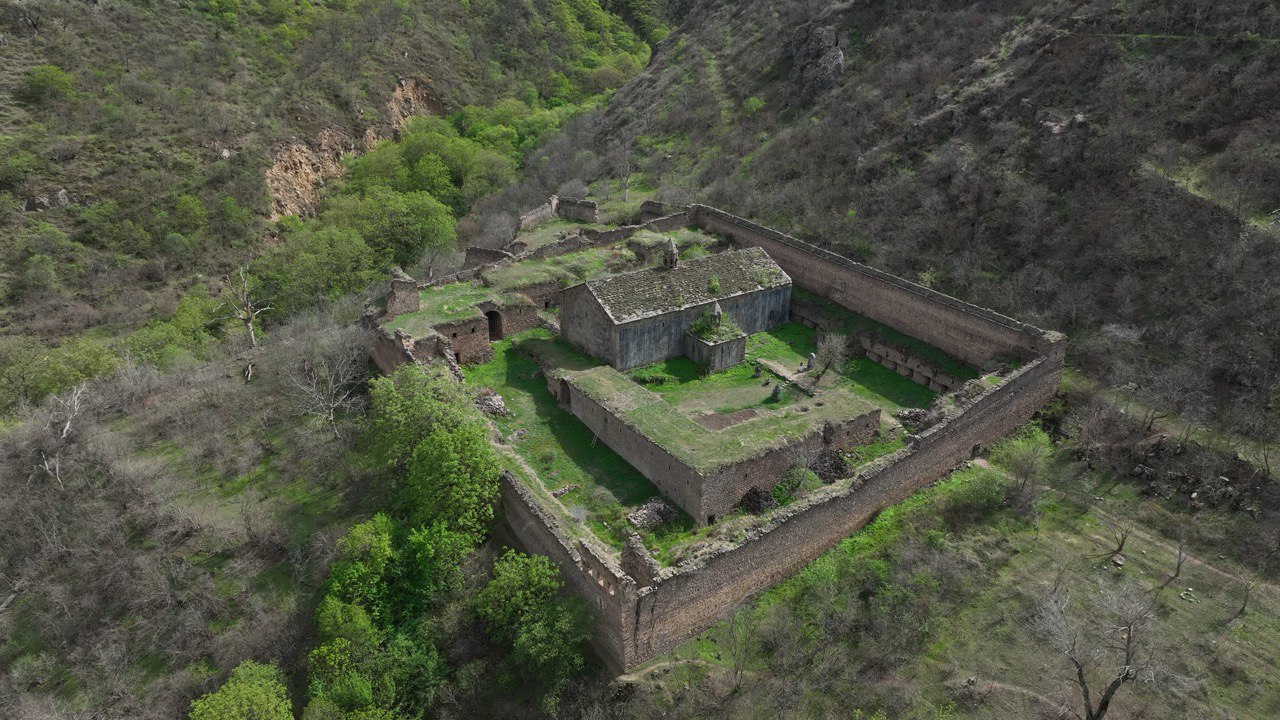
Harants Anapat
The Harants Desert medieval scientific and educational center was built in 1608-1610 on the plain in front of the Old Halidzor village and existed for about fifty years. Famous natural science textbooks and spiritual memoirs were created here. The half-ruined, but grandiose buildings of the old Harants Desert remain. The church, part of the walls, and other buildings are still standing. In 1658, a devastating earthquake destroyed the Great Syunik Desert of Halidzor (also called the Harants Desert). The latter became a serious reason for the idea of building the New Desert. In the second half of the 17th century, Hakob IV Jughayetsi decided to build the Great Desert of Tatev. It is located southeast of the village of Tatev, on the right bank of the Vorotan River, at the foot of Mount Tatev. After the construction of the Great Desert, the Harants Desert Congregation moved there. Sometimes in the pages of history these two deserts (Harants and Tatev Mets) are confused. The construction of the Tatev Mets desert began in 1660, and the reason for the destruction of the Harants desert was the earthquake of 1658. In 1663, the Church of the Holy Mother of God was built in the same desert, and in 1668 the desert already had 70 monks. The building of the living quarters with a L-shaped plan was built in 1682 for the local congregation.
In 1669, the founder of the Tatev Mets desert, Archpriest Aristakes, died, and was buried in the chapel-mausoleum of the church. From the middle of the 17th century to the first half of the 19th century, a number of structures were added to the desert: a refectory, a fence (1711), a three-arched vestibule-hall adjacent to the western facade of the church (1743).
The Church of the Holy Mother of God is a three-aisled basilica with two pairs of towers and a gable roof, located in the southwestern part of the complex.
A large refectory was built next to the southern wall, which is a vaulted hall with stone benches and tables. The refectory is quite bright, because according to the regulations of the Tatev Great Desert, the monks were supposed to read the Holy Scripture while eating.
The complex of the Tatev Great Desert is completely separated from the outside world by high walls; there are no openings on the walls, which stems from the peculiarity of deserts, which are created for isolation, asceticism, repentance, and being away from worldly life and nature.